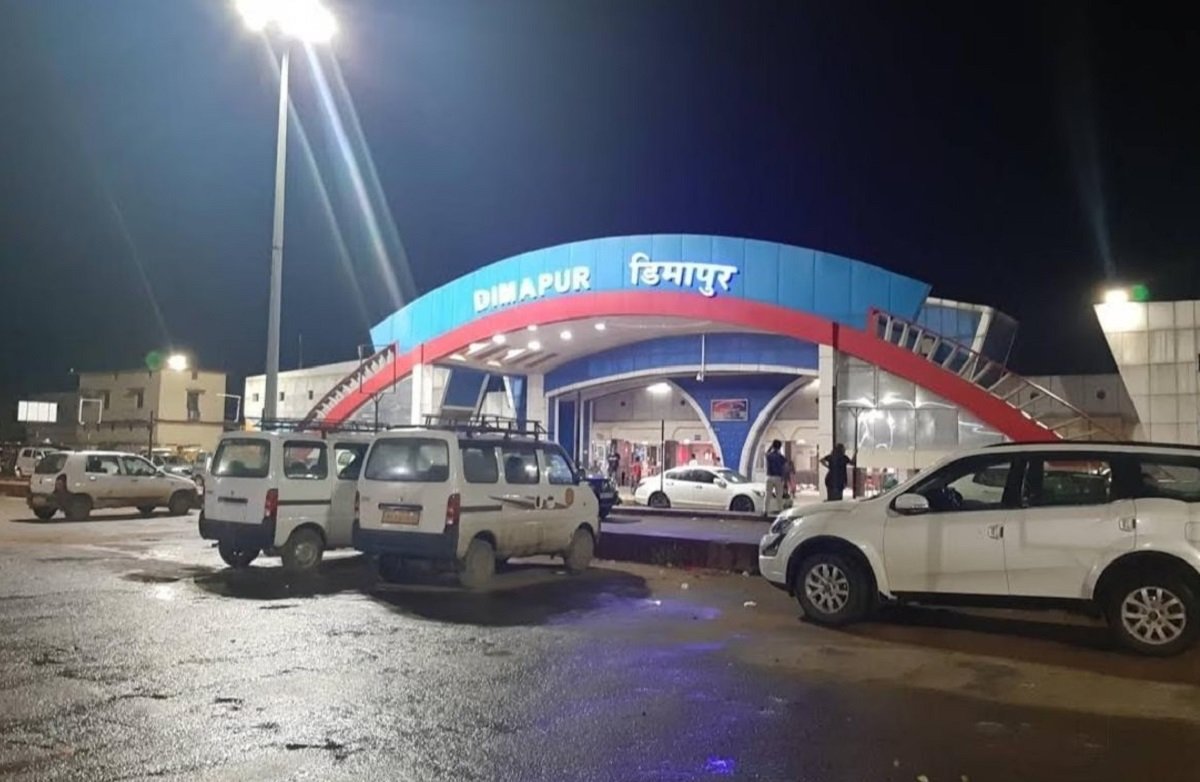
Dimapur Railway Station, one of the oldest rail stations in the Northeast, continues to face serious connectivity and seat availability issues despite being among the top revenue-earning stations under the Northeast Frontier Railway (NFR). Established in October 1903, the station has grown steadily over the decades and today handles nearly 10,000 passengers every day, including both incoming and outgoing travellers.
However, passengers say that this growth has not been matched by improvement in services. The number of seats available for passengers boarding from Dimapur remains very limited, and train timings are widely seen as inconvenient. Many regular travellers feel that the station’s importance has been overlooked, even as passenger numbers continue to rise.
According to figures made available by the NFR, Dimapur Railway Station has a total quota of only 1,128 seats from all ten passenger trains that stop at the station. For a station that serves nearly 10,000 passengers daily, this number is considered extremely low. As a result, passengers often struggle to get confirmed tickets, especially during peak travel days.
Over the years, there have been repeated demands for more trains and additional seat quotas from Dimapur. However, instead of increasing services, several trains that were originally introduced for Dimapur have been shifted elsewhere. The Jan Shatabdi Express, introduced in 1996, was moved to Jorhat in 1998. Later, the BG Express and the Nagaland Express, introduced in 1998 and 2011 respectively, were shifted to Mariani and Ledo in 2020.
The Nagaland Express, in particular, is remembered by many passengers as a very useful service. It used to depart Dimapur around 6 a.m. and reach Guwahati by late morning. This timing allowed passengers to complete official work, business meetings, or hospital visits and return to Dimapur the same day using evening trains. With the removal of this service, such same-day travel has become almost impossible.
At present, rail connectivity between Dimapur and Guwahati is considered inconvenient by most passengers. Many trains leave Dimapur between midnight and early morning hours and reach Guwahati late in the afternoon or evening. These timings are not suitable for people travelling for work, medical treatment, or official purposes.
The only relatively convenient daytime train is the BG Express, which leaves Dimapur at around 9.30 a.m. and reaches Guwahati at about 3.20 p.m. However, passengers say that this schedule still does not allow them to return on the same day, making it impractical for short trips.
While Shokhuvi Railway Station, which was recently opened, enjoys unlimited seating on certain trains such as the Donyi Polo Express and special services, Dimapur continues to struggle with limited quotas. This has further added to the frustration of passengers who feel that Dimapur’s needs are being ignored.
This reporter spoke to several passengers at Dimapur Railway Station, many of whom highlighted the importance of Guwahati as the commercial and financial centre of the Northeast. Traders and businesspersons from Dimapur frequently travel to Guwahati for banking work, procurement of goods, logistics coordination, and regulatory matters.
A local trader said that after the Nagaland Express was shifted, he now has to travel a day in advance or use road transport, which is both expensive and exhausting. “Earlier, we could go in the morning, finish work, and return by evening. Now that option is gone,” he said.
Medical patients and their families are also facing difficulties. One passenger, who regularly travels with a patient for hospital appointments, said that reaching Guwahati by late afternoon makes it impossible to attend appointments on the same day. “We reach around 4 p.m., and there is no way to return the same evening because the return train leaves much earlier,” he explained.
Another businessman pointed out that while returning from Guwahati to Dimapur is not a major problem due to the availability of several trains, travelling out of Dimapur remains the biggest concern. He added that Dimapur, despite being one of the highest revenue-generating stations under the NFR, continues to be underserved when it comes to passenger-friendly scheduling.
Passengers also expressed disappointment over the lack of strong intervention from the state government. They noted that in other states, issues related to railway connectivity are often raised by elected representatives in Parliament. In Nagaland, however, such concerns appear to have received little attention.
Railway officials, speaking informally, acknowledged the need for better services from Dimapur. Some officials admitted that introducing an early morning train to Guwahati would benefit not only passengers but also the NFR itself by increasing revenue and improving passenger satisfaction.