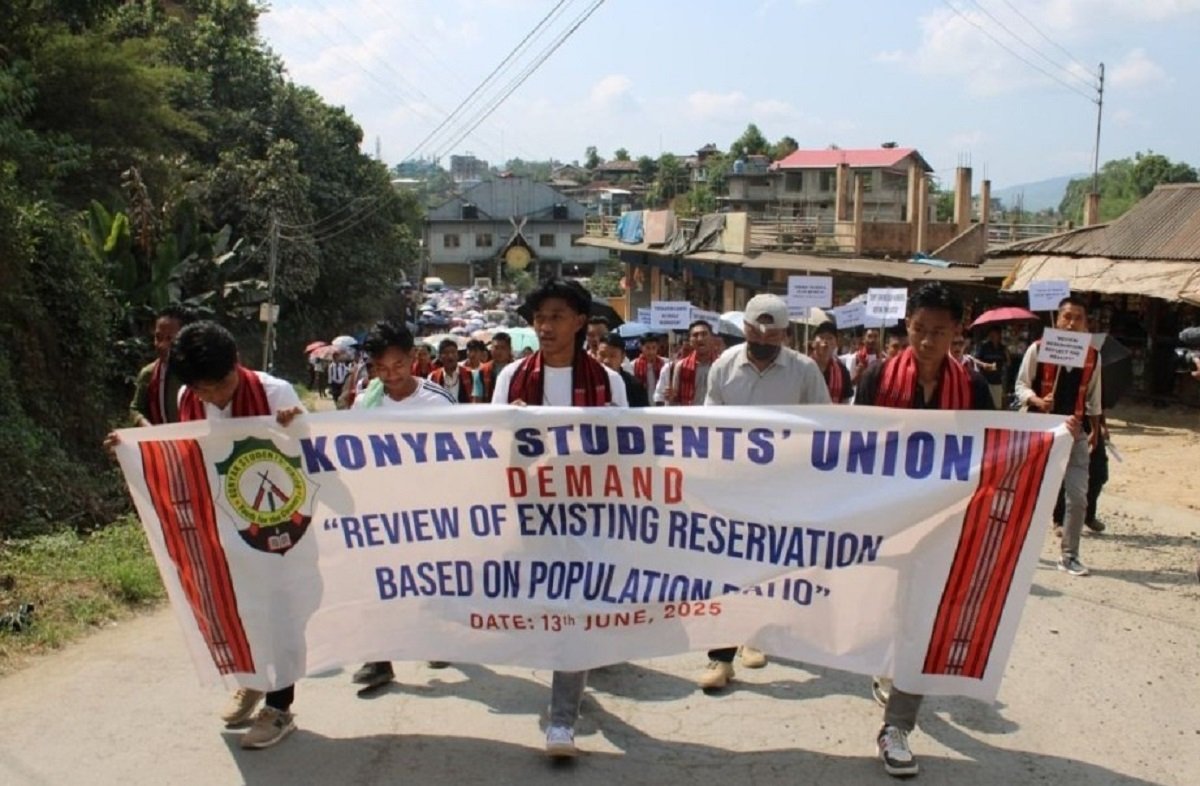
he Konyak Students’ Union (KSU) has urged the Nagaland government to urgently review the state’s job reservation policy, demanding that quotas be based on tribal population ratios. In a detailed representation submitted to the Chief Minister through the Deputy Commissioner of Mon, the Union called the current system discriminatory and unfair to the Konyak community, which it says has been historically marginalised. The KSU stressed that job reservation is a “right, not a concession” and sought a complete overhaul of the existing framework. Citing systemic neglect, the Union noted that the Konyak tribe, with a population of over 2.5 lakh — accounting for approximately 12.65% of Nagaland’s tribal population — remains underrepresented in government employment. Tracing the history of reservation in Nagaland, the KSU pointed out that the initial 25% reservation introduced in 1977 for seven backward tribes has been revised multiple times — in 1979, 2008, and 2011 — raising the total quota to 37%. However, the Union argued that these changes diluted the benefits for numerically larger tribes like the Konyaks. The 2015 notification, it said, further failed to ensure proportional representation.
The KSU put forward two key demands:
A comprehensive review of the state’s job reservation policy
Introduction of a population-based quota system to ensure fairness and equal opportunity
The Union highlighted stark inequalities. Despite comprising over 12% of the tribal population, Konyaks hold just 6% of government jobs. Mon district, home to the Konyaks, has the lowest literacy rate in the state at 56.99% and ranks at the bottom of the Nagaland Human Development Index, according to the 2016 state report. More than 86% of its population lives in rural areas, as per the 2011 Census. Warning of serious social consequences, the KSU said educated but unemployed Konyak youth are increasingly vulnerable to frustration and influence from anti-social groups. “The lack of employment is pushing our youth into insurgency and illegal activities,” the memorandum stated, describing the situation as a “social time bomb.” The Union emphasized that the state should not wait for the delayed 2021 Census data to act. Instead, it called on the Chief Minister to make a proactive Cabinet-level decision to correct what it calls a long-standing injustice.