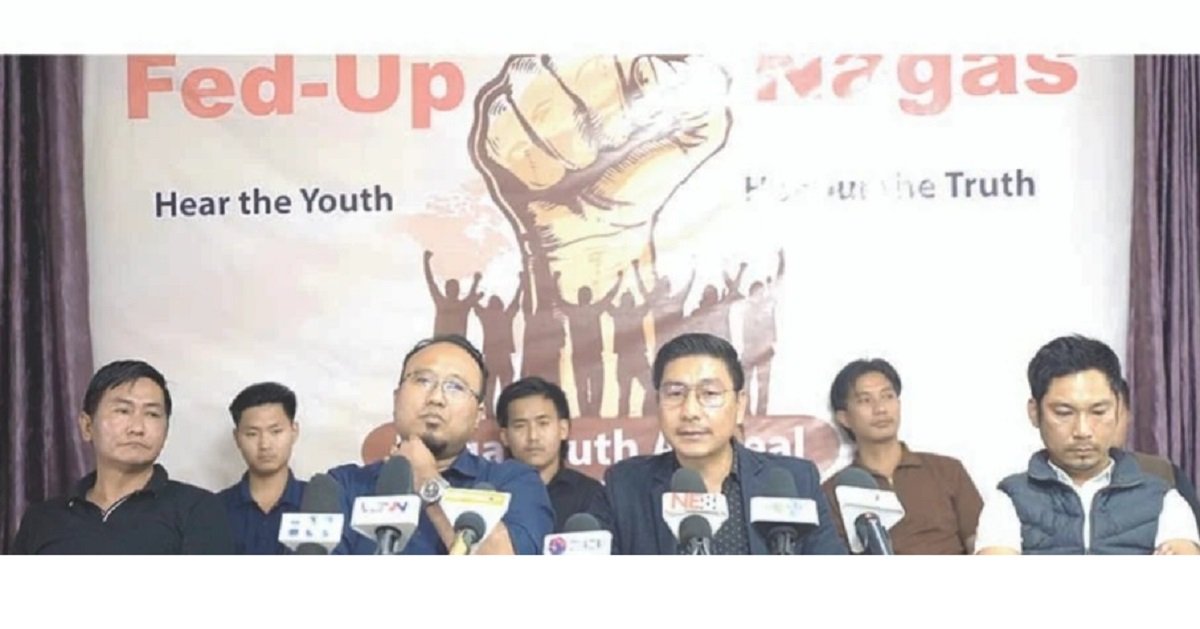
A group of Naga youths has come together under a common platform called “Fed-Up Nagas,” urging the Government of India to implement the long-pending Naga political agreements signed in 2015 and 2017. The appeal was made during a press conference held at a hotel in Dimapur, where speakers said the movement had emerged from growing frustration among young people over the prolonged delay in reaching a final political settlement. Addressing the media, Kahuto I. Awomi said the platform was not a formal organization, political party, tribal body, or association, but a collective voice of individuals from different Naga tribes and regions, including Nagas living outside the state. He explained that the movement has no formal leadership structure such as a president or convener and aims to represent the concerns of ordinary Naga youths who are affected by continuing political uncertainty.
According to him, the platform is asking only for the implementation of the agreements already signed — the Framework Agreement of August 3, 2015 with NSCN (I-M) and the Agreed Position of November 17, 2017 with the Working Committee of NNPGs. Speakers at the press meet said the initiative grew out of everyday discussions among young people who felt that the prolonged political delay was affecting their economic and social prospects. Awomi said many youths are struggling with unemployment, uncertainty, and limited opportunities, and therefore want an early resolution of the Naga political issue. He stressed that the platform does not seek new demands but only calls for honouring commitments already made through the peace talks. Another speaker, Ninoto Khekiye Chishi, said the movement does not target any individual, group, or organization but highlights the problems created by what he described as a system that has allowed temporary political arrangements to continue for many years. He stated that long-standing uncertainty has led to several social and economic challenges, including corruption, weak law enforcement, monopolistic practices, and the rise of syndicate-based control over business activities. According to him, such conditions have placed an additional burden on young people, who face limited opportunities while trying to build their future.
Chishi also spoke about the psychological impact of prolonged instability, saying that fear and silence have gradually become normal for many young people. He urged youths to choose peaceful participation and responsibility, stressing that the movement is a call for constructive action rather than confrontation. He emphasized that the platform strongly rejects violence and seeks only a peaceful and democratic solution. Aga Rengma, another representative, said the “Fed-Up Nagas” platform aims to represent the silent majority of Naga youths who are concerned about their future but often remain unheard. He said the name of the platform reflects widespread frustration among young people over corruption, nepotism, and repeated delays in implementing the political agreements. Rengma also reiterated support for the two agreements signed after decades of negotiations, stating that their implementation would help bring clarity and stability to the region.