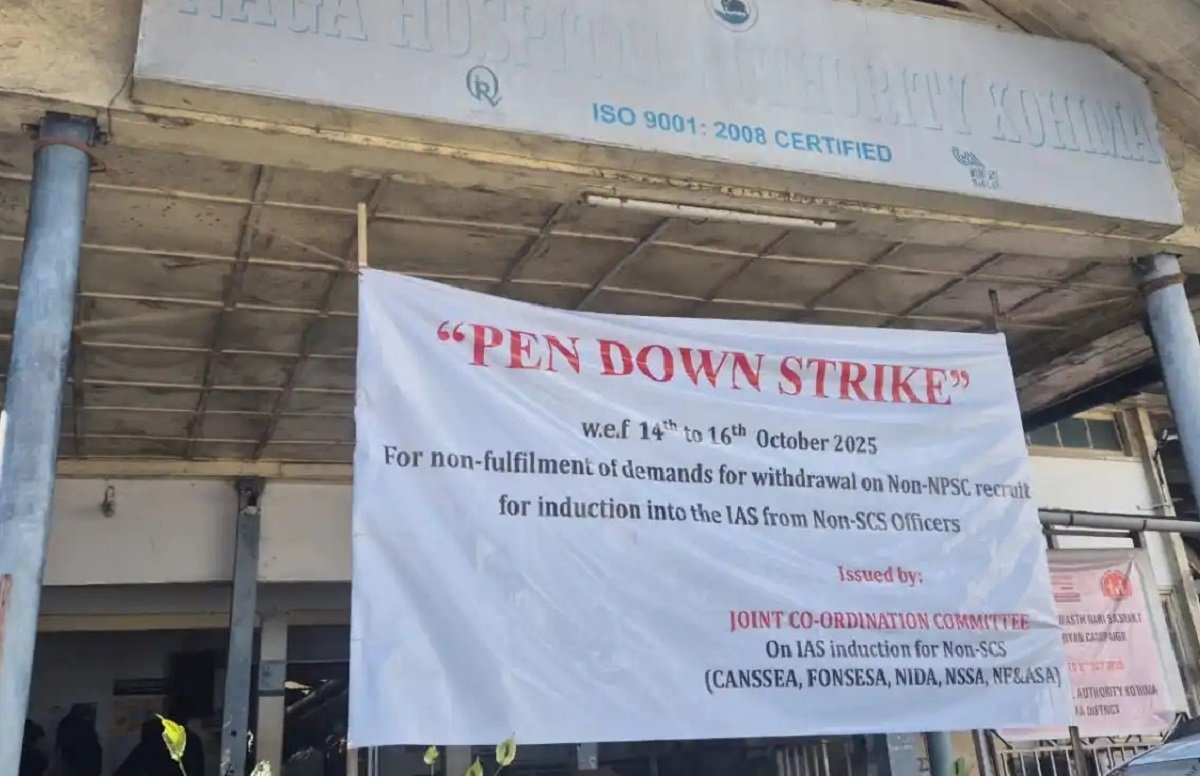
Nagaland’s major government service associations have stepped up their protest against what they describe as an attempt to bypass merit-based norms in the induction of a candidate into the Indian Administrative Service (IAS). The Joint Coordination Committee (JCC) — representing CANSSEA, NSSA, NF&ASA, NIDA, and FONSESA — has urged the public to stand for transparency and fairness in government recruitment as demonstrations enter a second month. The JCC has been staging symbolic protests since late September, beginning with a black badge campaign on September 24, followed by a Pen Down Strike from October 14. According to the committee, repeated letters and representations to the state government did not receive any response, forcing the groups to continue their agitation. In a public statement, the JCC stressed that the protest is not directed at any individual or the state leadership. Instead, it said the agitation aims to safeguard the principles of meritocracy and to prevent what it alleges is an effort to induct an ineligible candidate into the IAS “through non-transparent and irregular means.”
The controversy, the JCC said, began in 2018 when the Nagaland Civil Service Association recommended that only officers recruited through the Nagaland Public Service Commission (NPSC) should be considered for IAS induction. This rule was formally reflected in a government circular issued on July 6, 2020, with the Chief Minister’s approval. The provision was implemented to induct one non-State Civil Service officer into the IAS without objection from the Cabinet, DoPT, or UPSC.However, the situation changed this year. The JCC alleges that a March 10, 2025 notification reiterating the NPSC eligibility rule was abruptly withdrawn on April 24 and replaced with a revised circular that broadened eligibility to include non-NPSC recruits. According to the JCC, this change was intended to benefit a particular candidate.Under the original notification, 11 applications were received, 10 were found eligible, and five candidates — all with strong service records — were shortlisted. But the JCC claims that through procedural alterations and internal manipulation, the process was pushed to accommodate a non-NPSC officer, citing documents obtained through the Right to Information Act.
“When even the lowest government posts in Nagaland require NPSC or NSSB recruitment, there cannot be exceptions for the highest civil service induction,” the JCC declared. It argued that withdrawing the March circular and issuing a new one constituted favoritism and violated administrative norms.The JCC has submitted two key demands: cancellation of the panel list prepared under the April 24 circular, and reinstatement of the March 10 notification in full. The organisations asserted that restoring the original guideline is crucial to protecting the integrity of the recruitment system and maintaining public trust. “The JCC’s movement is a call of conscience,” the statement said. “We are fighting to protect the sanctity of governance so that the highest administrative positions are filled only through merit and due process.” The committee has appealed to citizens to support the cause in the interest of accountability, fairness, and future generations.