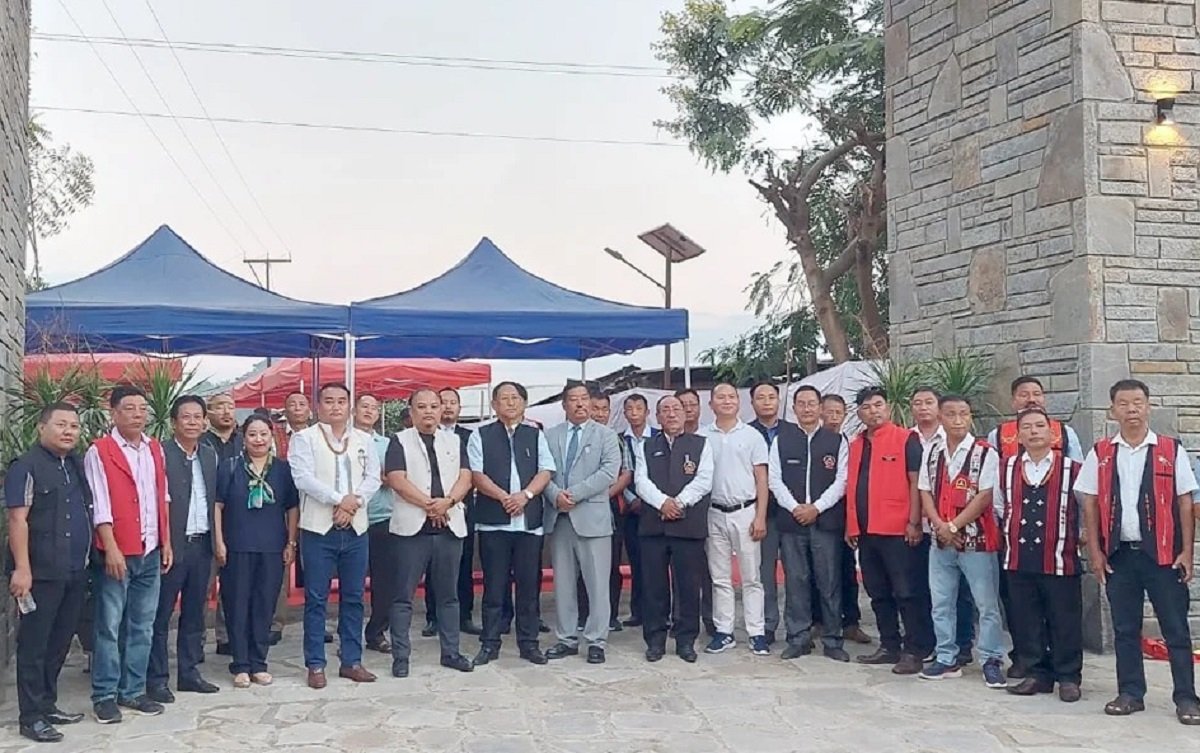
The Naga Colony in Dimapur witnessed a significant moment on Saturday as the newly constructed colony gate and the Unity Stone of the Nagas were formally inaugurated and unveiled. The ceremony was led by MLA and Advisor for Urban Development and Municipal Affairs, Zhaleo Rio, along with MLA and Advisor for Tribal Affairs and Election, H. Tovihoto Ayemi. The event took place at Naga Colony, adjacent to Reliance Smart Point, and drew community leaders, elders, and residents. Speaking as the special guest, Zhaleo Rio described the new village gate as a powerful symbol of Naga identity, unity, and cultural strength. He said the monument reflects what can be achieved when leaders and the public work together with cooperation and shared purpose. He emphasized that the unveiling of the gate and Unity Stone stands as a testament to the collective effort of the colony and its leaders.
Rio recalled the contribution of the late Keneinguzolie Zakiesato, father of Zasivikho Zakiesato, describing him as one of Dimapur’s early settlers whose dedication helped shape the city. He expressed happiness that the family continues his legacy through positive community work. He urged other tribes to draw inspiration from such examples, adding that unity must always be accompanied by peace and appreciation. Highlighting the importance of constructive engagement, Rio noted that people often focus on shortcomings while ignoring the progress already made. He encouraged the public to point out genuine issues but also acknowledge good work, as such recognition motivates leaders and workers. He called for more civic responsibility, stressing that although Nagaland has a high literacy rate, more needs to be done to instill values of hygiene, waste management, and environmental awareness.
Addressing challenges such as degraded drainage systems and heavy rainfall, Rio said Nagaland’s ecological balance is being disrupted by human activities. He added that poor national rankings attributed to the state often stem from an inaccurate population census rather than a lack of progress on the ground.