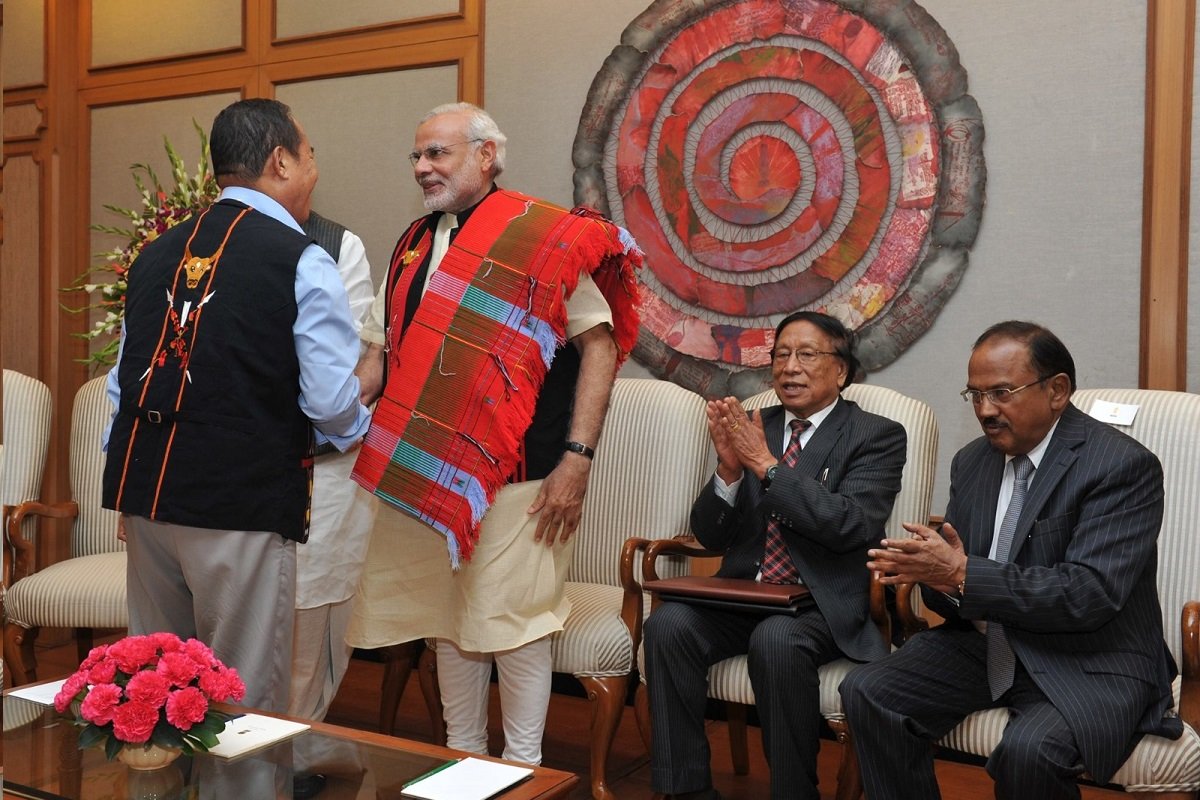
Prime Minister Narendra Modi on Friday described the newly signed tripartite agreement on Eastern Nagaland as a “historic” development that is expected to accelerate growth and open new opportunities for people in the region. The agreement, signed on Thursday between the Central government, the Nagaland government and the Eastern Nagaland Peoples’ Organisation (ENPO), aims to strengthen development planning, administrative decentralisation and long-term stability in the eastern districts of the state.
Calling the accord an important milestone, the Prime Minister said the agreement would strengthen the development path of Eastern Nagaland while ensuring peace, progress and inclusive growth across the region. He said the initiative reflects the government’s continued focus on resolving regional issues through dialogue and cooperation, while creating conditions for sustainable economic and social development.
The agreement was signed in the presence of Union Home Minister Amit Shah and Nagaland Chief Minister Neiphiu Rio. One of the central provisions of the pact is the proposed creation of the Frontier Nagaland Territorial Authority (FNTA), a new administrative body intended to improve local governance and accelerate development programmes in the eastern part of the state. The authority will cover six districts—Tuensang, Mon, Kiphire, Longleng, Noklak and Shamator—areas that have for many years demanded stronger administrative attention and balanced development.
Officials said the proposed FNTA will be entrusted with responsibilities over 46 subjects, allowing it to take a more direct role in planning and implementing development activities in the region. The move is expected to bring administrative decision-making closer to the people and ensure that local priorities receive timely attention. The agreement also provides for the establishment of a mini-secretariat for the authority, which will be headed by senior state officials and will function as the administrative centre for coordinating programmes and projects.
Another important aspect of the agreement is the mechanism for the allocation and sharing of development funds. According to officials, resources for Eastern Nagaland will be distributed in proportion to population and geographical area, ensuring that the region receives financial support that reflects its developmental needs and challenges. At the same time, the government clarified that the arrangement will not affect the special constitutional protections provided to Nagaland under Article 371(A), which safeguards the state’s customary laws, land rights and traditional practices.
Union Home Minister Amit Shah described the agreement as a significant moment for the North East, saying it represents another step towards building a region free from long-standing disputes and instability. He said that in earlier decades, unresolved issues and armed conflicts had affected several parts of the North East, slowing down development and creating uncertainty for communities. According to him, the present government has focused on resolving such issues through continuous dialogue, consultation and partnership with local organisations and state governments.
Shah also said that since 2019, the government has signed 12 major agreements across different parts of the North East, aimed at addressing long-pending demands and strengthening peace processes. He added that the government’s present approach is not limited to signing accords but also includes ensuring that each agreement is implemented effectively and delivers visible benefits to people on the ground. Implementation, he said, is being closely monitored so that development initiatives reach the intended communities without delay.
Leaders and observers believe the Eastern Nagaland agreement represents an important structural change in governance for the region. For many years, organisations representing the eastern districts had raised concerns about uneven development and limited administrative representation. The creation of a dedicated territorial authority is expected to provide a more focused institutional mechanism for addressing these concerns, particularly in sectors such as infrastructure, education, healthcare and livelihood generation.
Chief Minister Neiphiu Rio said the agreement reflects cooperation between the Centre, the state government and local stakeholders, adding that such coordinated efforts are essential for achieving long-term development goals. He expressed hope that the new administrative arrangement would help accelerate projects in remote districts and bring more opportunities for youth, entrepreneurs and local communities.