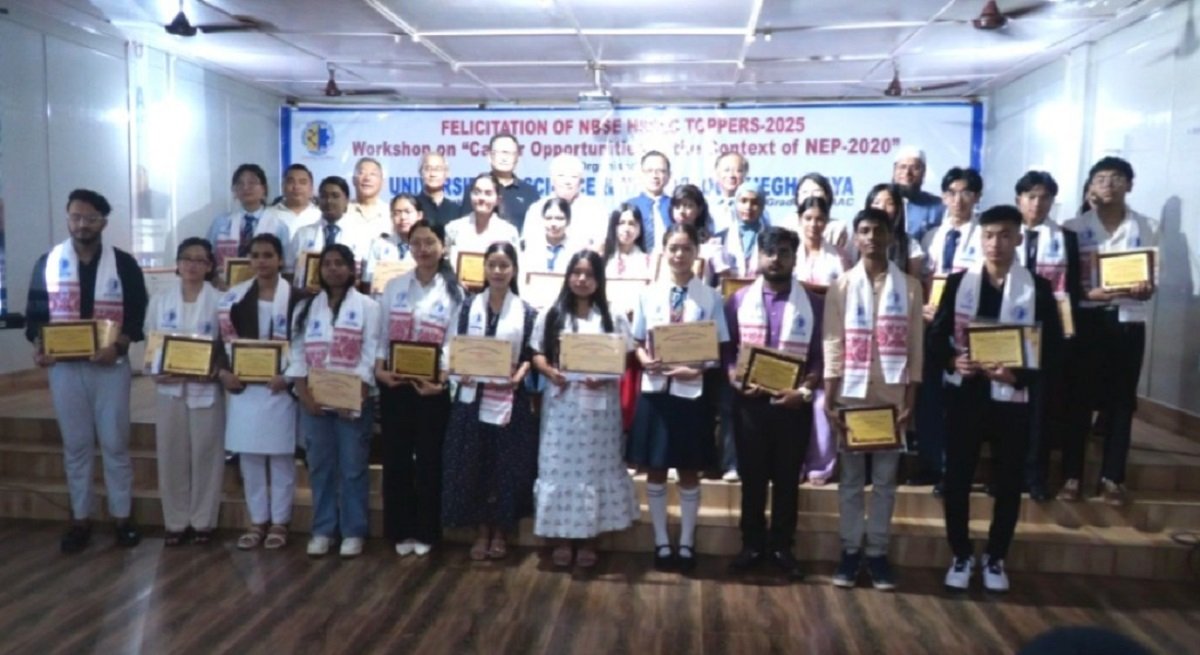
On Friday, the University of Science and Technology Meghalaya (USTM) hosted a workshop at Livingstone Foundation International (LFI) with the theme “Career Opportunities in the Context of NEP-2020” in partnership with Nagaland University (NU) and North East Christian University (NECU). A felicitation function honoring the Top 10 NBSE HSSLC and LFI school toppers was also part of the event.
The keynote speaker and main guest was Alemtemshi Jamir, the former Nagaland chief secretary. He commended USTM for acknowledging the achievements of its students. He commended the best performers and underlined the importance of the National Education Policy (NEP) 2020, characterizing it as a shift away from colonial educational models and toward a system that is skills-based and self-sufficient.
According to Jamir, NEP 2020 is India’s calculated reaction to world economic developments, with the goal of giving young people the skills they need to find work and support themselves. He exhorted pupils to accept the policy as a chance to develop their “goodness and greatness,” rather than just as a change. Speaking about Nagaland’s own difficulties, Jamir emphasized the state’s misguided emphasis on corporate and industrial jobs at the expense of its own advantages. He claimed that rather than using their own visions, Nagas were pursuing those of others. “We’re not examining our advantages. We are examining the strengths that others have demonstrated to us,” he said.
Jamir reflected on previous attempts to bring the Tuli Paper Mill back to life and pointed out that the state is still not ready for industrialization, even with the Center’s substantial support. He listed the lack of skilled labor, banking restrictions related to land ownership, and Article 371(A) as the main barriers to investment in Nagaland. Jamir pointed to the state’s agricultural foundation, where about 68% of the population works, and stated that it has potential as a youth alternative economy. He urged educators and students to reframe NEP 2020 to fit the particular circumstances of Nagaland, emphasizing sustainability, rural innovation, and converting technology into workable solutions for rural livelihoods.
Speaking on the subject, Prof. Pauline Alila, HoD of Horticulture and Pro Vice-Chancellor in-charge at Nagaland University, emphasized that NEP 2020 is a revolutionary change meant to create a workforce prepared for the twenty-first century.
According to Prof. Alila, NEP 2020 places a strong emphasis on technological integration, vocational training, holistic, multidisciplinary learning, and industry partnership in order to match education with changing market demands. She pointed out that the strategy encourages critical thinking, creativity, multilingualism, skill-based education, and subject choice freedom.
In order to promote entrepreneurship and global competitiveness, she continued, the NEP seeks to establish a learner-centric system with more job options in the academic, vocational, and creative fields.
Prof. Alila concluded by saying that NEP 2020 equips students to explore a variety of disciplines, make educated judgments, and prosper in a changing society. She said, “It’s about teachers and parents empowering and mentoring students—giving them the freedom to choose, the ability to explore, and the skills to thrive.” Previously, Dr. Kughatoli Aye and Dr. Mehjabeen Rahman chaired the program. Er. Debasish Saha, Director of Operations and Director of IQAC, USTM, presented a PowerPoint on “Career Opportunities – What’s Next?” Following NECU Vice Chancellor Dr. Darlando T. Khathing’s greetings and a brief speech by USTM Vice Chancellor Prof. G.D. Sharma, USTM Chancellor Mahbubul Hoque gave the welcoming address.