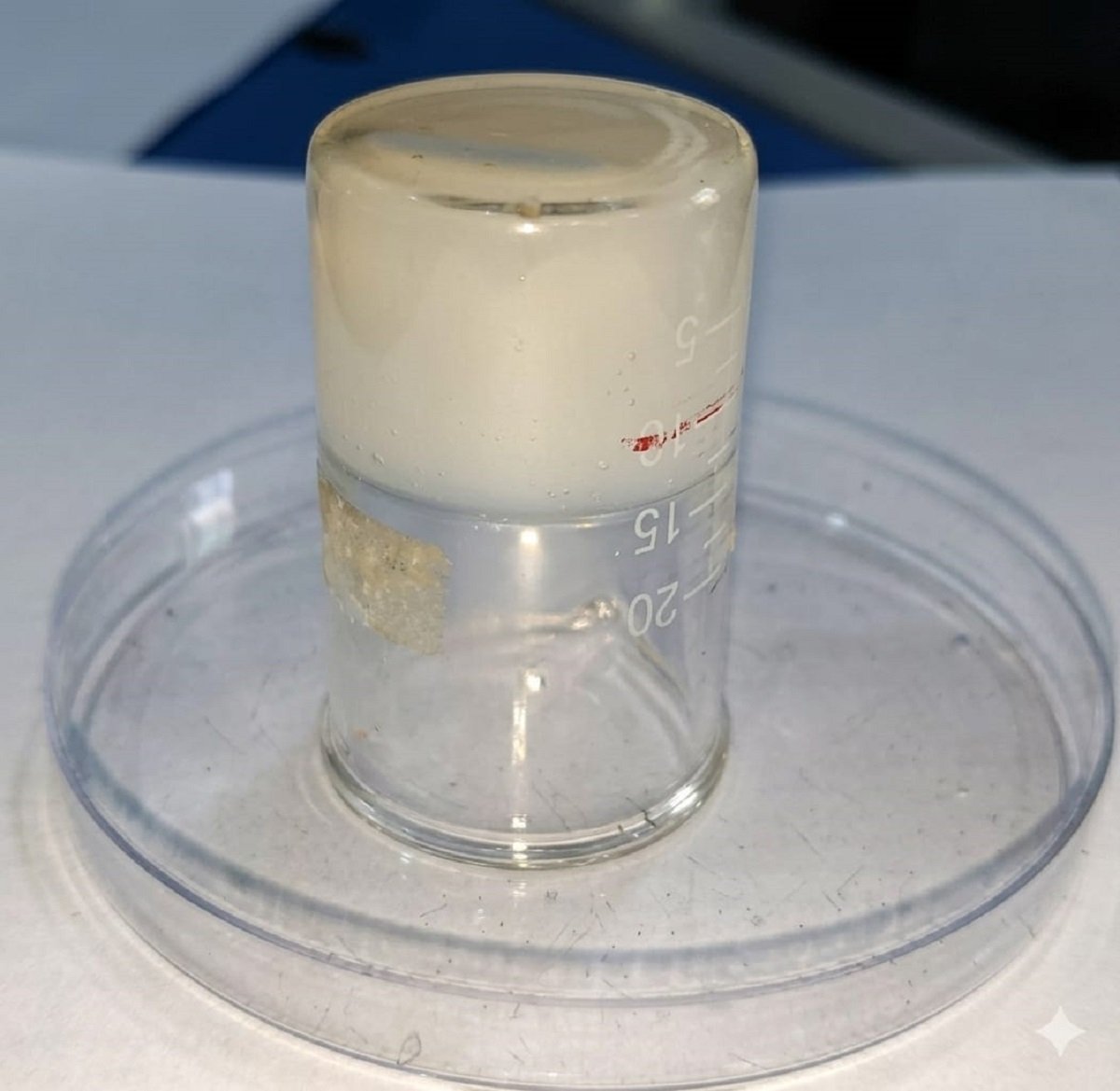
Nagaland University researchers have developed a sustainable and robust hydrogel membrane electrolyte using the natural biopolymer chitosan that offers a safer and environmentally friendly alternative to conventional liquid electrolytes used in supercapacitors.
The team further demonstrated the practical applicability of the technology by developing a prototype supercapacitor capable of powering a red LED indicator.
Supercapacitors are advanced energy storage devices that can charge and discharge rapidly and operate for thousands of cycles. They are widely used in applications such as renewable energy systems, electric vehicles, and portable electronic devices. However, conventional liquid electrolytes used in these systems often suffer from leakage, volatility, and safety concerns.
To address these challenges, the Nagaland University research team has developed an innovative quasi-solid hydrogel electrolyte based on chitosan, a biodegradable natural polymer. In this system, potassium oxalate acts as an ionic crosslinker, where oxalate anions interact with protonated amino groups of chitosan to create a stable three-dimensional network capable of efficient ion transport.
The result is a hydrogel membrane that combines the high ionic conductivity of liquid electrolytes with the mechanical stability of solid materials, making it suitable for use in durable solid-state electrical double-layer capacitors (EDLCs).
The research findings were published in the International Journal of Biological Macromolecules, a reputed peer-reviewed international Q1 journal published by Elsevier with an Impact Factor of 8.5 and a Cite Score of 10.3.
The paper was co-authored by Nagaland University research scholars Dipankar Hazarika, with Nuphizo Shijoh and Marjo A. Kichu as co-researchers, under the supervision of Dr. Nurul Alam Choudhury.
Highlighting the need for researchers to study critical technologies, Prof. Jagadish K. Patnaik, Vice Chancellor of Nagaland University, said, “Nagaland University has achieved a significant breakthrough in sustainable energy research with the development of a chitosan-based hydrogel electrolyte for solid-state supercapacitors. This innovative, quasi-solid hydrogel membrane—derived from natural polymers—offers enhanced safety, improved durability, and superior performance compared to conventional electrolytes. The advancement marks an important step toward eco-friendly and reliable next-generation energy storage technologies, reinforcing the university’s commitment to cutting-edge research and sustainable development.”
The supercapacitor built using this electrolyte showed excellent durability, maintaining stable performance till 46,000 charge-discharge cycles. This indicates that the technology can support long-lasting and reliable energy storage devices.
Elaborating on this research, Dr. Nurul Alam Choudhury, assistant professor, Department of Chemistry, Nagaland University, said, “The hydrogel electrolyte demonstrated excellent performance when tested in supercapacitor devices. It enabled efficient ion movement and stable energy storage, enabling the device to deliver reliable energy output. The system also showed good energy storage capacity, highlighting its potential for next-generation supercapacitors.”
Lead researcher Dipankar Hazarika, research scholar, Nagaland University, said, “At present, our technology has reached Technology Readiness Level (TRL-3), meaning that experimental proof-of-concept has been successfully demonstrated under laboratory conditions.” Our research has also led to the formation of a start-up initiative based on hydrogel electrolyte materials emerging from Nagaland University, highlighting its commercialization potential.”
Co-researcher Nuphizo Shijoh, research scholar, Nagaland University, said, “This innovation could contribute significantly to the development of safer, high-performance, and environmentally sustainable energy storage systems that support renewable energy integration, electric mobility, and next-generation electronic devices.”
The next phase of the research will focus on scaling up the fabrication of hydrogel membrane electrolytes, integrating them into commercial supercapacitor modules, and testing their performance under real-world operating conditions. Future work will also explore flexible and wearable energy storage devices based on this technology.