Researchers at the Indian Institute of Technology (IIT) Guwahati have developed a novel brain-inspired Artificial Intelligence (AI) model capable of processing long sequences of data while consuming significantly less energy than several conventional AI approaches.
The research, developed by scientists from IIT Guwahati’s Mehta Family School of Data Science and Artificial Intelligence, was presented at the prestigious International Conference on Machine Learning (ICML) 2026 in Seoul, South Korea. ICML is considered a top-tier, CORE A*-ranked international conference in the field of artificial intelligence and machine learning.
The new model could have applications in areas requiring continuous and efficient analysis of large volumes of sequential data, including wearable health monitoring, Internet of Things (IoT) sensors, smart manufacturing, environmental monitoring, autonomous systems and long-term forecasting.
The technology could help reduce computational requirements, potentially extending battery life in portable devices and enabling AI systems to operate directly on devices with reduced dependence on cloud computing.
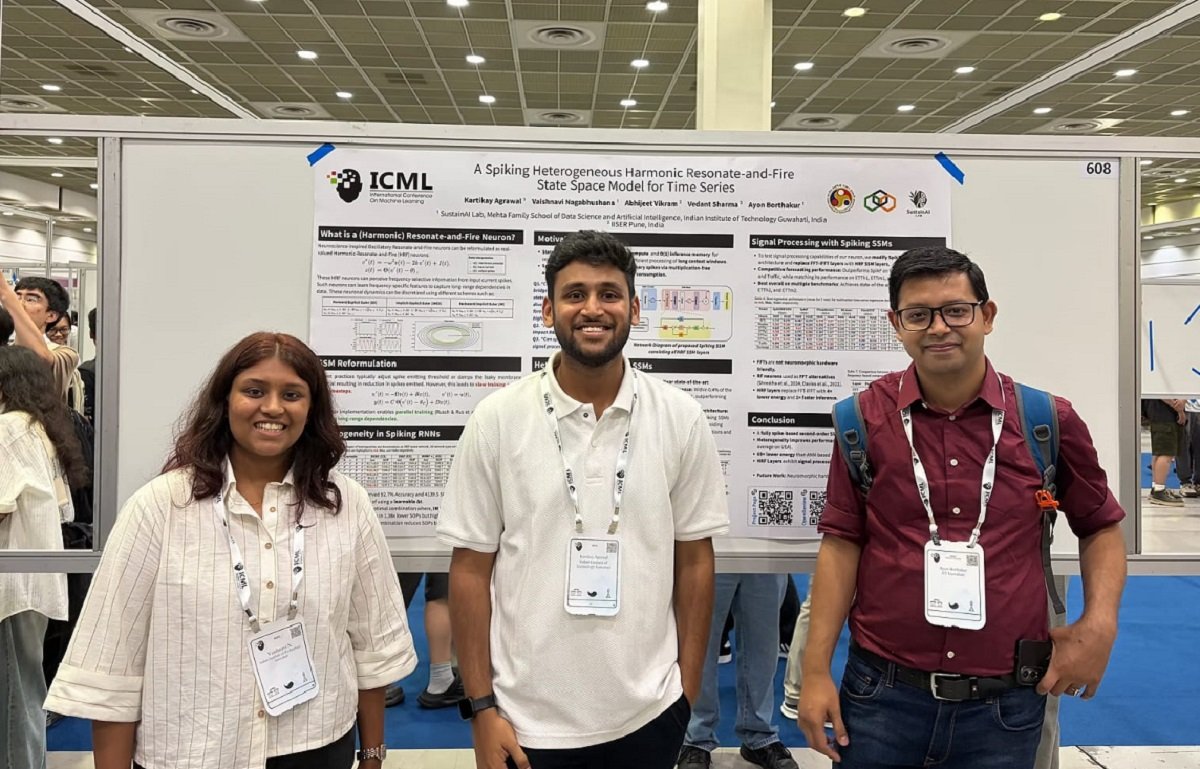
Developed by researchers at IIT Guwahati’s SustainAI Lab, the model is titled ‘Spiking Heterogeneous Harmonic Resonate-and-Fire State Space Model’ (SH²RFSSM). The research was presented as a poster at ICML 2026.
The study was co-authored by Kartikay Agrawal, Vaishnavi Nagabhushana, Abhijeet Vikram, Vedant Sharma and Ayon Borthakur. Kartikay Agrawal, Vaishnavi Nagabhushana and Ayon Borthakur presented the work during the ICML 2026 poster session at the COEX Convention and Exhibition Center in Seoul on July 7, 2026.
Explaining the need for the research, Dr Ayon Borthakur, Assistant Professor at the Mehta Family School of Data Science and AI, IIT Guwahati, said modern AI systems increasingly need to analyse long streams of sequential information, such as health signals from wearable devices, environmental sensor readings, industrial data, and weather and traffic forecasts.
However, conventional AI architectures can become increasingly computationally expensive as the length of the input data grows, making them less suitable for battery-powered and resource-constrained devices, he said.
To address this challenge, the IIT Guwahati researchers developed SH²RFSSM, which draws inspiration from the event-driven communication mechanisms of biological neurons.
Kartikay Agrawal, PhD Research Scholar at the Mehta Family School of Data Science and AI, said conventional neural networks continuously process information, whereas spiking neural networks activate only when meaningful events occur. This allows them to perform computation more sparsely and efficiently.
The researchers combined this spiking-neural-network principle with advanced state-space modelling, enabling the system to learn long-range patterns without the heavy computational requirements associated with many traditional sequence-processing models.
Another distinctive feature of SH²RFSSM is neuronal heterogeneity, in which individual artificial neurons can have different characteristics instead of behaving identically. According to the researchers, this diversity helps the model capture complex temporal patterns present in real-world sequential data.
The team evaluated the model on 17 benchmark datasets covering long-range sequence classification, regression, human activity recognition and long-term forecasting.
The researchers said the model achieved performance comparable to state-of-the-art sequence models while demonstrating substantially lower estimated energy consumption.
The findings could therefore pave the way for more energy-efficient AI systems capable of processing continuous, long-range data directly on resource-constrained devices.
Vaishnavi Nagabhushana, PhD Research Scholar at the Mehta Family School of Data Science and AI, said the team plans to further investigate the model’s potential in real-world applications involving continuous and long-range data processing.
The researchers will focus on improving its efficiency and adaptability, with the aim of enabling wider deployment on resource-constrained devices and supporting practical edge-AI applications.
New IIT Guwahati AI Model Processes Long Data Sequences With Lower Energy Use