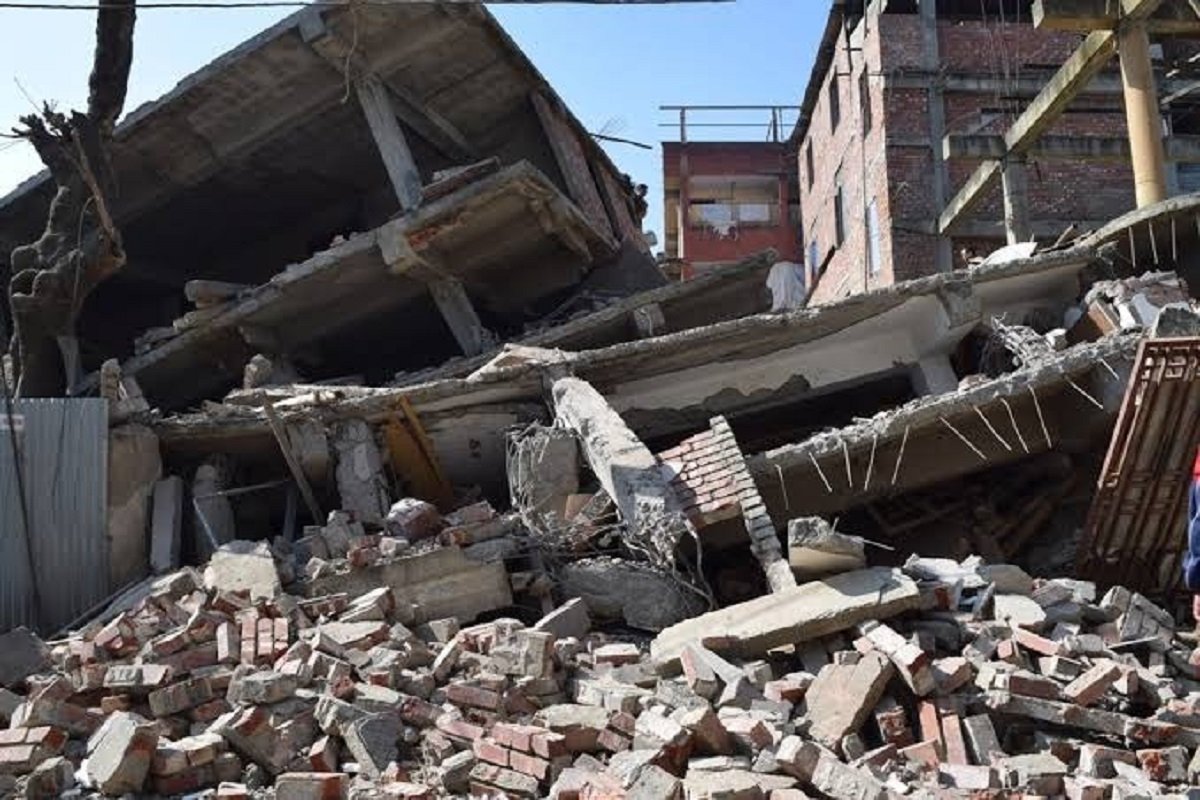
Researchers at the Indian Institute of Technology (IIT) Guwahati have developed a new methodology to assess earthquake-induced ground shaking across Northeast India, with the study identifying Imphal as the city facing the highest estimated ground-shaking intensity among eight major cities in the region.
The findings, published in the Journal of Seismology, examine regional variations in seismic activity while accounting for uncertainties in historical earthquake data and the locations of geological faults.
Northeast India is considered one of the country’s most earthquake-prone regions due to its location between two major tectonic boundaries, the presence of the Shillong Plateau, and numerous active fault systems. The region has witnessed several devastating earthquakes in the past, including the 1897 Shillong earthquake and the 1950 Assam earthquake.
The study was conducted by Prof. Abhishek Kumar of IIT Guwahati’s Department of Civil Engineering and his former research scholar, Dr. Niranjan Borah, who is currently an assistant professor at Barak Valley Engineering College.
For the research, the team compiled a database of nearly 6,000 earthquakes recorded over the last 1,200 years. To address uncertainties in historical records, the researchers generated 200 synthetic earthquake catalogues by varying earthquake magnitudes and locations within specified uncertainty limits.
Using a statistical approach known as Latin Hypercube Sampling, the researchers developed a framework that incorporates regional differences in earthquake occurrence as well as the orientation of geological faults.
The study found that the Indo-Myanmar Ranges experience the highest level of seismic activity, followed by western Arunachal Pradesh, central Assam, the Shillong Plateau and southern Sikkim.
Researchers also evaluated seismic hazards in eight Northeastern cities, including Guwahati, Agartala, Imphal, Shillong, Aizawl, Kohima, Gangtok and Itanagar. Using Peak Ground Acceleration (PGA) as a measure of expected ground shaking, the study concluded that Imphal faces the highest estimated shaking intensity among the cities assessed.
According to the researchers, the findings could help engineers and planners design safer buildings and infrastructure capable of withstanding future earthquakes. They noted that combining these estimates with local soil-condition assessments would provide a more accurate picture of earthquake hazards in the region.
The research team plans to further refine the model by incorporating factors such as earthquake depth and recurrence patterns to strengthen future seismic hazard assessments in Northeast India.