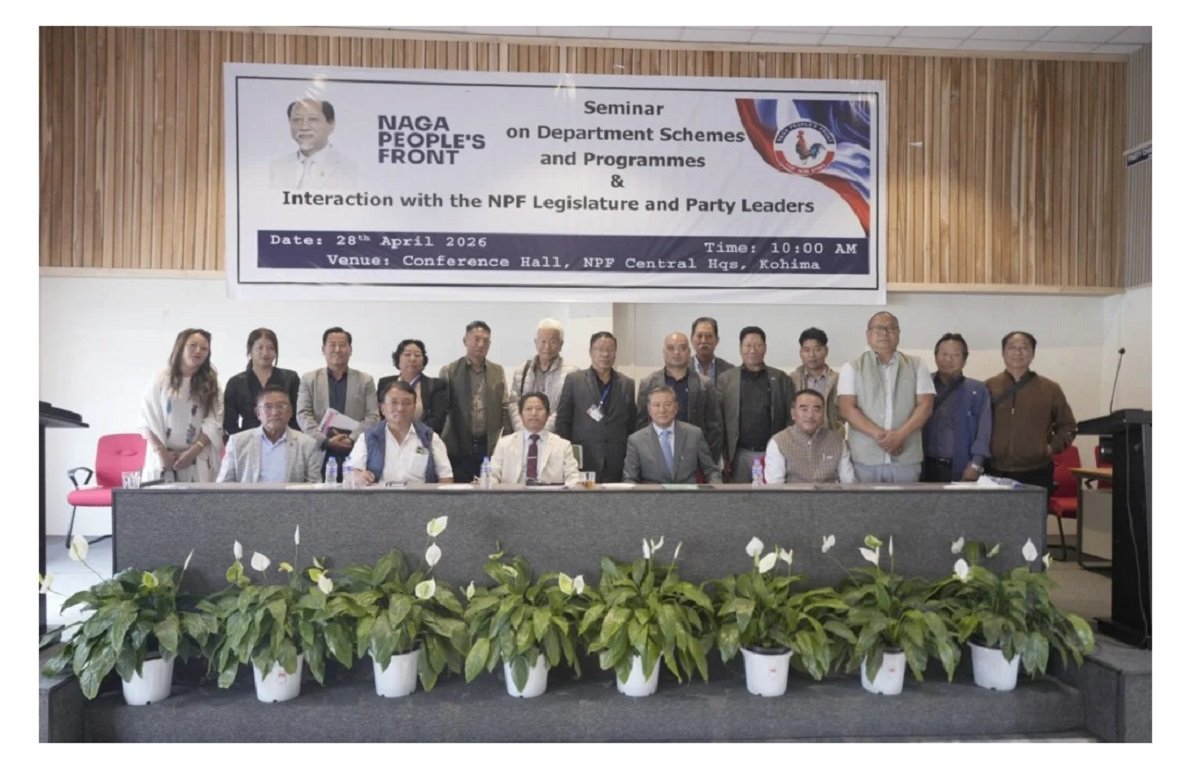
The Naga People’s Front stressed the need for better implementation of government welfare schemes, stronger grassroots coordination and improved delivery systems during a seminar held at the party’s central headquarters in Kohima. The seminar brought together party legislators, senior leaders and functionaries who discussed a wide range of issues linked to agriculture reforms, digitisation of the Public Distribution System (PDS), land resource development, census participation and electoral roll verification. Party leaders said stronger coordination between government departments, local authorities and grassroots workers was necessary to ensure that development schemes reach people effectively, especially in rural and remote areas. Addressing the gathering, Agriculture Advisor Mhathung Yanthan spoke about the state government’s recently approved agriculture policy, which has also been passed in the Assembly. He said the policy aims to transform agriculture in the state from a subsistence-based activity into a more market-oriented and climate-resilient sector.
Yanthan noted that a large section of the population in Nagaland still depends on agriculture for livelihood. He said the focus would now be on scientific farming methods, mechanisation and encouraging greater participation of young people in the agriculture sector. He also announced the introduction of seven new high-yielding and climate-resilient rice varieties, which he said could help improve agricultural productivity and support farmers facing changing weather conditions. Advisor for Food and Civil Supplies and Legal Metrology K.T. Sukhalu said the state has shifted to a Smart Public Distribution System from May 2025 in an effort to improve transparency and monitoring in ration distribution. According to him, the new system allows real-time monitoring through digital platforms. He said Aadhaar-based authentication through electronic point-of-sale devices has now been made compulsory for beneficiaries. Sukhalu further said manual distribution methods have been stopped under the new system and households earning more than Rs 2.5 lakh annually have been removed from free ration beneficiary categories.
Advisor for Land Resources G. Ikuto Zhimomi highlighted ongoing initiatives related to watershed management, spring rejuvenation and plantation crop expansion across the state. He said there was strong potential for increasing coffee and rubber cultivation in Nagaland and projected that coffee plantations could be expanded to around 50,000 hectares while rubber cultivation could grow to nearly 30,000 hectares in the future. Zhimomi also stressed the need for fair and non-political selection of beneficiaries under development schemes and called for stronger coordination between officials and district-level authorities.