
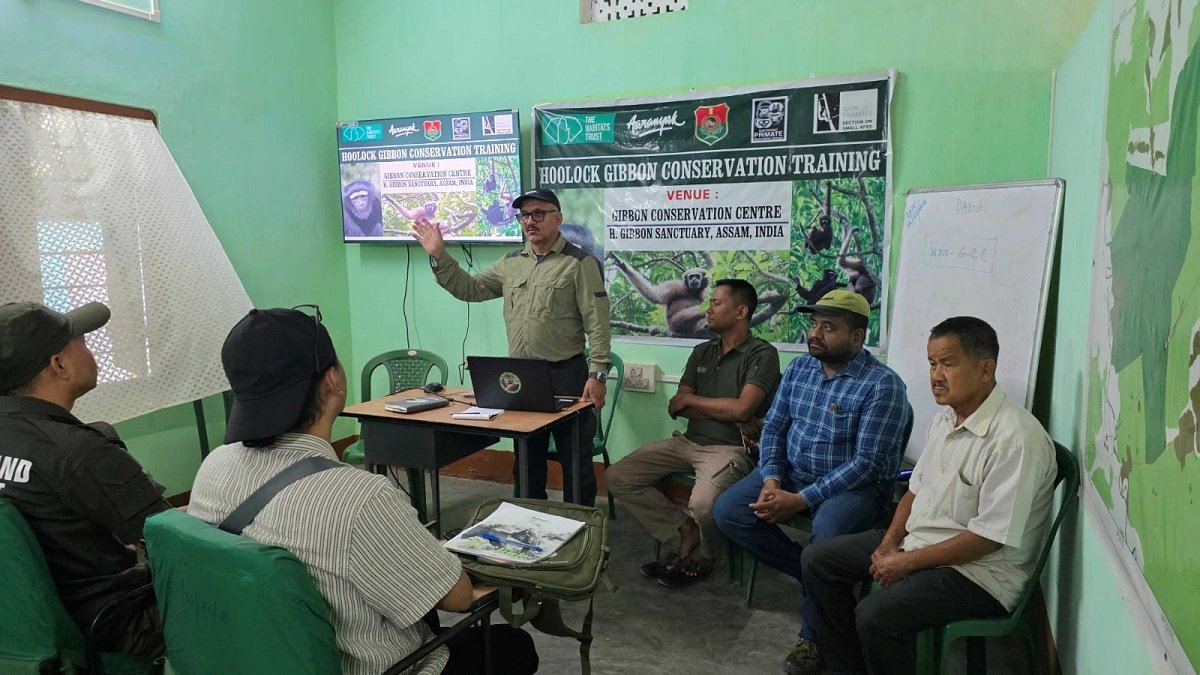
In a concerted effort to strengthen Hoolock Gibbon conservation in Northeast India, wildlife conservation organisation, Aaranyak, organised a week-long residential training programme for forest guards from Assam, Meghalaya and Nagaland. The initiative, conducted in collaboration with the Assam Forest Department, particularly the Jorhat Forest Division, received support from The Habitats Trust, the IUCN Primate Specialist Group and the IUCN Section on Small Apes.The Western Hoolock Gibbon is distributed across the seven northeastern states of India, south of the Dibang-Brahmaputra river system. However, habitat fragmentation and hunting remain major threats to its survival. Lack of basic information about the species and inadequate conservation awareness among various sections of society, including frontline forest personnel, further compound the challenges. Despite being directly involved in field-level protection, many forest guards have limited exposure to the different aspects of Hoolock Gibbon conservation strategies.Recognising these challenges and the need to strengthen conservation efforts across Assam, Meghalaya and Nagaland, Aaranyak conceptualised the training series titled “Training of Forest Guards for the Conservation of Hoolock Gibbon”, aimed at enhancing the knowledge and field-level capacities of frontline forest personnel.
The training covered a comprehensive range of subjects, including biodiversity and conservation in Northeast India; primate conservation with special reference to the Hoolock Gibbon; gibbon census and population estimation; data collection, maintenance and reporting; techniques of floristic studies; gibbon habitat characteristics and restoration; population and habitat monitoring; gibbon rescue and rehabilitation; the use of Global Positioning System (GPS) technology in fieldwork; and legal orientation covering wildlife laws and their application.
Through classroom lectures and field-based exercises, the programme introduced participants to the fundamental principles of primatology and provided practical exposure to the methods and techniques used in field research and conservation.
The training programme was inaugurated recently by Dr. Dilip Chetry, Director and Head of Aaranyak’s Primate Research and Conservation Division and Vice Chair of the IUCN Primate Specialist Group South Asia. Welcoming the participating forest guard trainees from the three states, Dr. Chetry highlighted that the initiative was the first of its kind in Northeast India and emphasised its importance in building the capacity of frontline personnel for biodiversity conservation.He urged the participants to make the best use of the training to enhance their understanding of Hoolock Gibbon conservation in particular and biodiversity conservation in general. Highlighting the alarming conservation status of the species in Northeast India, he stressed the need for collective support and coordinated efforts from all stakeholders to ensure its survival.Bishnu Gogoi, Beat Officer, thanked Aaranyak for organising the training programme at Hollongapar Gibbon Sanctuary and urged the participating trainees to maintain discipline and actively engage throughout the programme.A total of 16 forest guards from Assam, Meghalaya and Nagaland participated in the week-long training.The training programme concluded with a valedictory and certificate distribution ceremony on November 18 last, chaired by Dr. Dilip Chetry. During the concluding session, Dr. Chetry expressed his gratitude to the Assam, Meghalaya and Nagaland Forest Departments for deputing their personnel to participate in the programme. He also acknowledged the support extended by the Assam Forest Department, particularly the Jorhat Forest Division, and the local community, whose cooperation contributed to the successful conduct of the training.He encouraged the trainees to apply the knowledge and practical skills acquired during the programme towards protecting forest habitats and strengthening conservation efforts for the Western Hoolock Gibbon.The programme concluded with the distribution of certificates of participation and learning materials, including training manuals, books on the Hoolock Gibbon, awareness posters and stickers.


