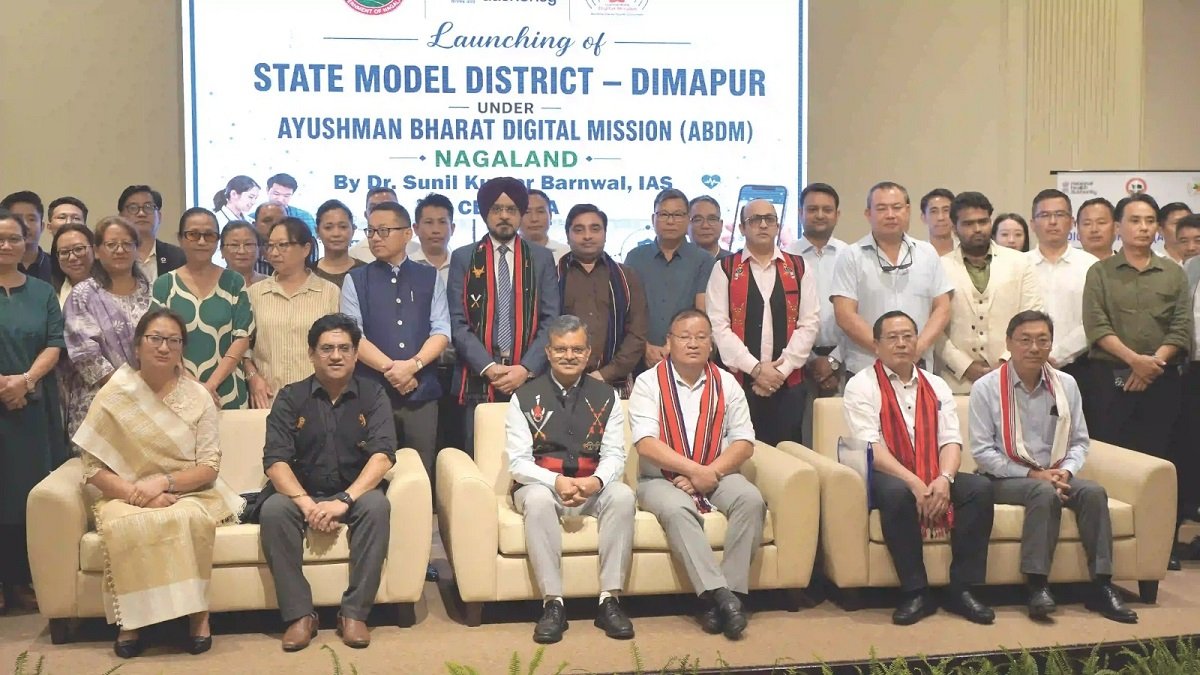
In a major step towards digital healthcare transformation, Dimapur has been designated as Nagaland’s first Model District under the Ayushman Bharat Digital Mission (ABDM), with authorities aiming to establish a fully digital healthcare ecosystem within the next four months.
The initiative was launched by National Health Authority (NHA) Chief Executive Officer Dr Sunil Kumar Barnwal during a workshop organised by the Health & Family Welfare Department in collaboration with the NHA at Niathu Resort on Thursday.
Addressing the gathering, Barnwal said ABDM would transform healthcare delivery by enabling a seamless, data-driven and patient-centric system. He noted that fragmented medical records often hinder effective treatment and said the mission seeks to create an integrated digital health ecosystem where hospitals, pharmacies and diagnostic centres can securely share patient information with consent.
He informed that over 92 crore Ayushman Bharat Health Account (ABHA) IDs have been generated nationwide, while nearly 8.96 lakh people, accounting for around 38 per cent of Nagaland’s population, have already been enrolled. He called for accelerated efforts to achieve universal coverage in the state.
Barnwal said the digital framework is built around ABHA IDs, the Health Facility Registry and the Health Professional Registry, enabling verified digital identities for patients, healthcare institutions and medical professionals. He added that digital records would improve efficiency, transparency and continuity of care while reducing dependence on physical documents.
Highlighting the significance of the model district initiative, Barnwal said Dimapur was chosen to demonstrate that comprehensive digital healthcare transformation can be achieved within a short timeframe. He urged healthcare institutions to move beyond basic digitisation and adopt complete digital record management systems.
Deputy Commissioner of Dimapur, Dr Tinojongshi Chang, described the initiative as a landmark move towards accessible, efficient and inclusive healthcare, assuring full administrative support for its implementation. Barnwal also clarified that ABDM does not maintain a central repository of medical records, stressing that patient data would remain with the originating healthcare facility and be accessible only to authorised providers and the patient through consent-based sharing.