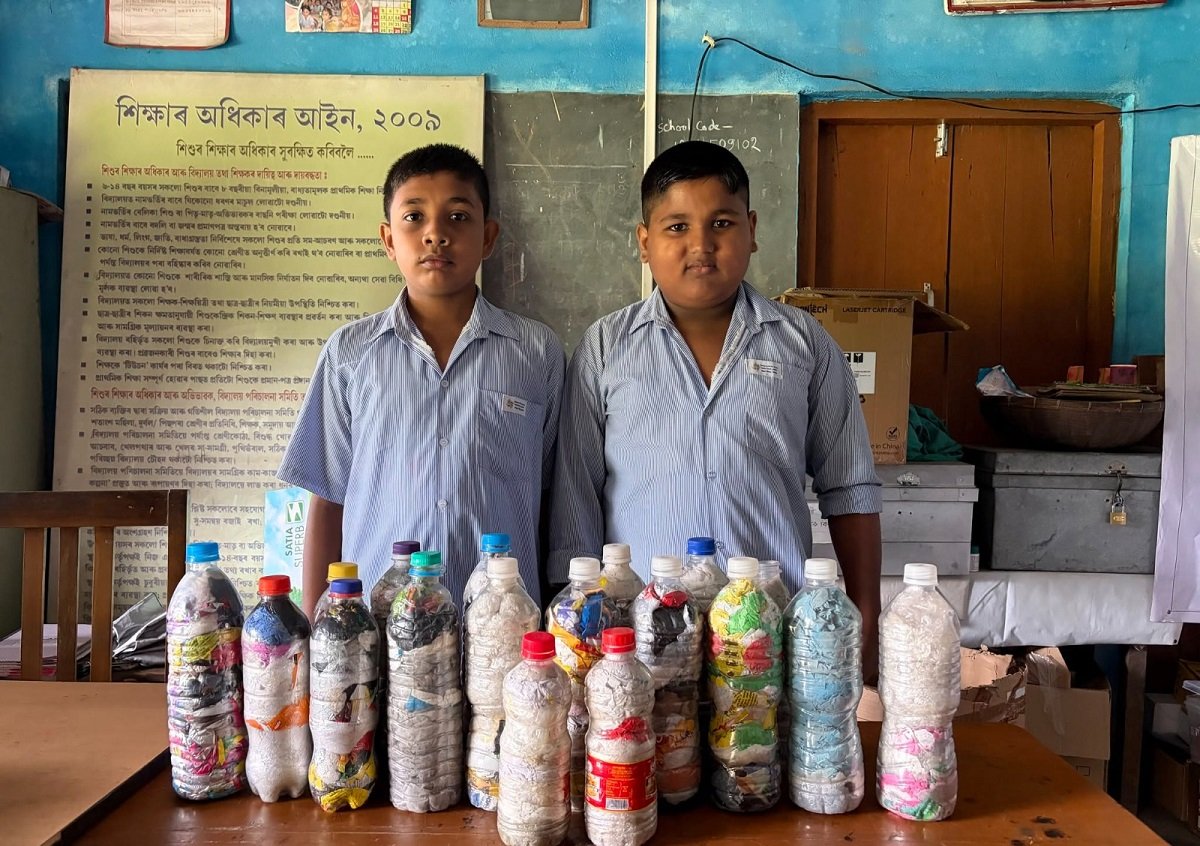
In an inspiring effort to tackle plastic pollution, students across several schools in Assam are transforming discarded single-use plastic into eco-bricks and using them to build useful structures within their campuses. The initiative is not only helping reduce environmental waste but is also instilling a sense of responsibility and sustainability among young learners.
At Mainakhurung MV School in Garchuk-Pamohi, Headmistress Kalpana Boruah said the programme has encouraged students to understand the harmful effects of plastic pollution while contributing positively to society. The eco-bricks produced by the students are used to create school infrastructure, and participants earn points that can later be exchanged for essential educational materials.
According to Boruah, interest in the activity has grown significantly over the past year. Students actively collect plastic waste from their homes and neighbourhoods, often spending their free time making eco-bricks.
A similar enthusiasm was evident at Dahali Karka High School, where students have committed themselves to keeping their surroundings free of plastic waste. The school collects plastic waste from nearby localities every week, encouraging community participation in the campaign.
Teachers say the initiative has become increasingly successful due to the involvement of parents and educators. Jajneswar Nath, Head Teacher of Dahali Karka High School, noted that the programme has effectively nurtured environmental awareness, while teacher Ajit Mahanta highlighted the role of teachers and parents in motivating students.
The initiative is being spearheaded by the Pamohi-based Akshar Foundation, which follows Mahatma Gandhi’s Nai Talim philosophy emphasizing experiential and hands-on learning. The foundation has expanded the programme from its model school to government schools across the state. Currently, 61 government schools in Assam are part of the campaign, including schools in Kamrup and Kamrup Metro districts.
During the last academic year, students created 9,163 eco-bricks and recycled more than 3,200 kilograms of plastic. These eco-bricks were used to construct 39 structures, including benches, boundary walls, garden borders, tree guards and playground facilities.
The Akshar Foundation has also partnered with the Guwahati Municipal Corporation to launch the Swachh Schools Swachh Shehar Campaign, extending the initiative to private schools. Thirteen private schools in Guwahati have joined the effort, collectively contributing nearly 8,892 kilograms of plastic waste.
An eco-brick is made by tightly packing non-biodegradable plastic waste into used plastic bottles until they become strong enough for construction purposes. Each eco-brick contains around 500 grams of plastic and is tested to ensure it can bear weight.
Students receive reward points for making eco-bricks, with each point valued at Rs 1 under the foundation’s Aspiration Market incentive programme. These points can be redeemed for educational items such as school bags, stationery and geometry boxes.
According to Hirak Baishya, Partnership and Communications Manager of Akshar Foundation, the programme not only promotes environmental conservation but also teaches financial literacy by encouraging students to save and spend their earned points wisely. He added that the initiative has reduced the economic burden on families and helped children continue their education.
The model has attracted national and international attention. Prime Minister Narendra Modi mentioned the initiative in his Mann Ki Baat programme, while the Ministry of Information and Broadcasting praised it for redefining educational practices. Similar models have since been adopted in government schools in Mumbai and Varanasi.
The foundation’s work has also gained global recognition, with interns from Oxford University visiting the Akshar Forum annually. Selected interns have represented the organisation at the United Nations Human Rights Council in Geneva.