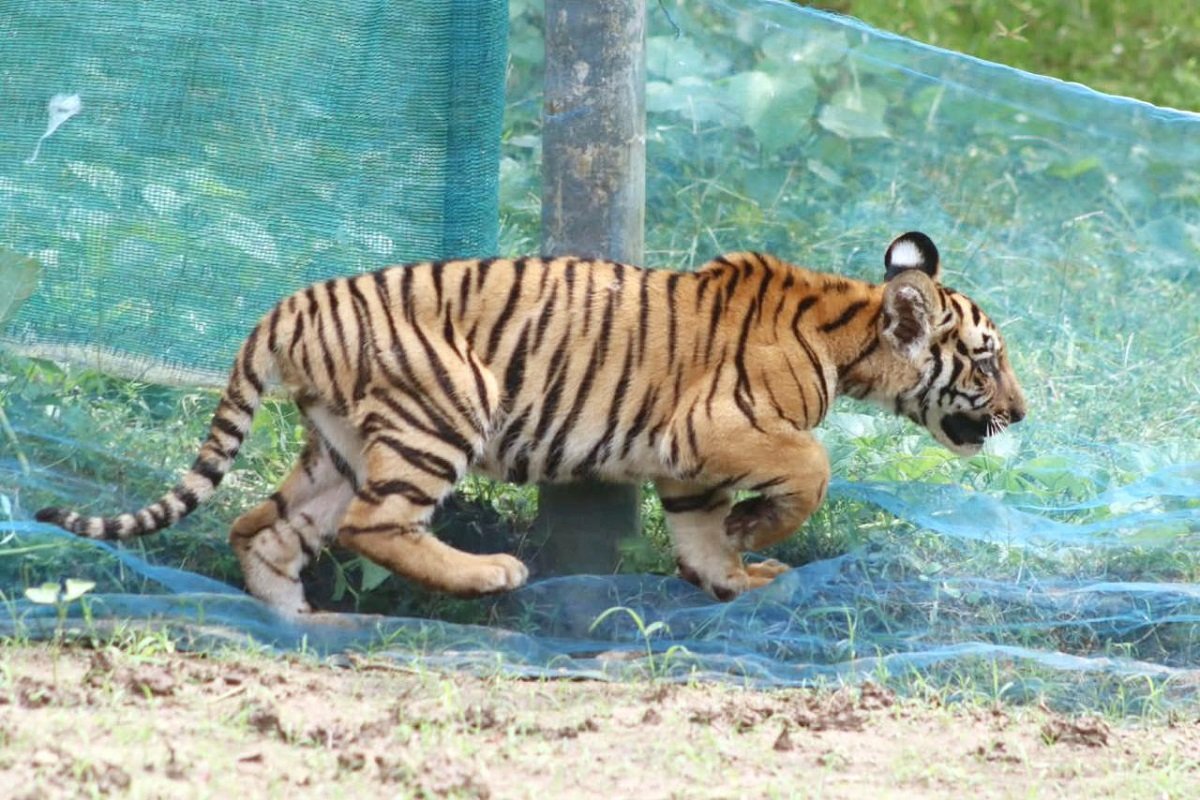
A tiger cub, estimated to be three months old, was rescued after it was found in a kitchen garden of a house in Natugaon village in Assam’s Biswanath district on the morning of 17 September, 2026. Its forelimbs were entangled in agricultural and fishing nets surrounding the kitchen garden. On being alerted to the sighting by concerned residents, a coordinated rescue effort was carried out by the forest department, police, district administration and the Wildlife Trust of India (WTI).
It was likely that the juvenile tiger had been separated from its mother due to strong river currents. The team promptly secured the area while also surveying the neighbouring riverine islands to locate the mother. However, no evidence of an adult tigress was found. The rescue team strategically guided the animal into a transportation crate and shifted the individual to the Central Range Office for veterinary observation. “The rescue was accomplished without the use of chemical immobilisation, considering the young age of the animal,” stated Dr. C. Ramesh, Field Director, KNP & TR.
A team comprising Dr. Subhasish Arandhra, Ecologist, WTI, Dr. Deepak Sarma, veterinarian and frontline staff also surveyed the nearby riverine islands upstream in search of tiger or juvenile pugmarks.
Based on information and evidence indicating that a mother with cubs had been present in the area recently, it was decided to attempt a reunion in the evening, led by Dr. Panjit Basumatary of WTI’s Centre for Bear Rehabilitation and Conservation (CBRC). The tiger was shifted to an upstream riverine island in Murkhuwa and Bhawani using a mechanised country boat (bhut-bhuti). The team continued to provide the animal with the necessary food and hydration. A camera trap was installed at the release site to gather evidence of an adult tigress in the area before the team returned.
“As advised by Mr. Ritu Paban Borah, DFO, Biswanath Wildlife Division, a drone survey was conducted the following day to assess the condition of the site and the surrounding area. The tiger was observed to still be present at the location. However, the survey also indicated that the river water level was rising, creating a risk that the cage and surrounding area could become submerged,” explained Shri Nayan Jyoti Gogoi, AFS, Assistant Conservator of Forests, Biswanath Wildlife Division.
The tiger was subsequently moved to a more secure location that provided opportunities for distant monitoring, as well as ease of access for necessary health checks and supplementary feeding. The site was selected following an assessment of the surrounding habitat and likely tiger movement routes.
The following day, on 19 September, the tiger was reported to have made its way out of the cage on its own. The forest department is continuing to monitor the area and has placed camera traps around the release site. “While pugmark evidence was found on 23 September, approximately 200 metres from the release crate, we remain hopeful of capturing images of the tiger cub in the coming days. Camera-trap monitoring will continue over the coming weeks,” said Dr. Basumatary.